
The Role of Wind Deflectors in Modern Convertible Design
The Role of Wind Deflectors in Modern Convertible Design
OCMEE Design Engineering Insights – Aerodynamics & Thermal Comfort Series
Convertible refinement is not a styling problem.
It is an aerodynamic and thermal control problem disguised as emotion.
For decades, open-top vehicles promised freedom while delivering turbulence, buffeting, noise, and cold air recirculation that no amount of HVAC power could overcome. At speed, the absence of a roof exposes the cabin to separated flow structures, unsteady vortices, and pressure-driven backflow that turn driving into a compromise between sensation and comfort.
Wind deflectors quietly changed that equation.
What began as simple screens evolved into boundary-control devices that fundamentally reshaped convertible architecture. Today, they operate not as accessories, but as integrated subsystems: interacting with aerodynamics, thermal management, NVH, and user experience to transform open-air driving from a seasonal indulgence into a refined, repeatable condition.
This article explores how wind deflectors achieved that shift.
And by the end, you’ll walk away with ten of the most important insights behind modern convertible comfort, not marketing claims, but physics-driven realities.
The Chaotic Origins: When Wind Was the Ultimate Spoiler
Convertibles weren’t born luxurious. They were necessities. In the early 1900s, cars like the Ford Model T were open by default: no roofs, no mercy from the elements. As enclosed cabins rose in the 1920s, drop-tops became a badge of adventure for thrill-seekers. Yet, the physics fought back. At highway speeds, air gliding over the windshield separates at the header, birthing massive recirculating vortices, think swirling tornadoes in your backseat. These “horseshoe vortices” pull high-pressure air from behind, spiking interior winds to 30-40% of vehicle speed and noise to over 100 decibels. Low-frequency buffeting (10-30 Hz) pounds your eardrums like a subwoofer, while wind chill drops perceived temps by 10-15°C, turning necks into ice rinks.
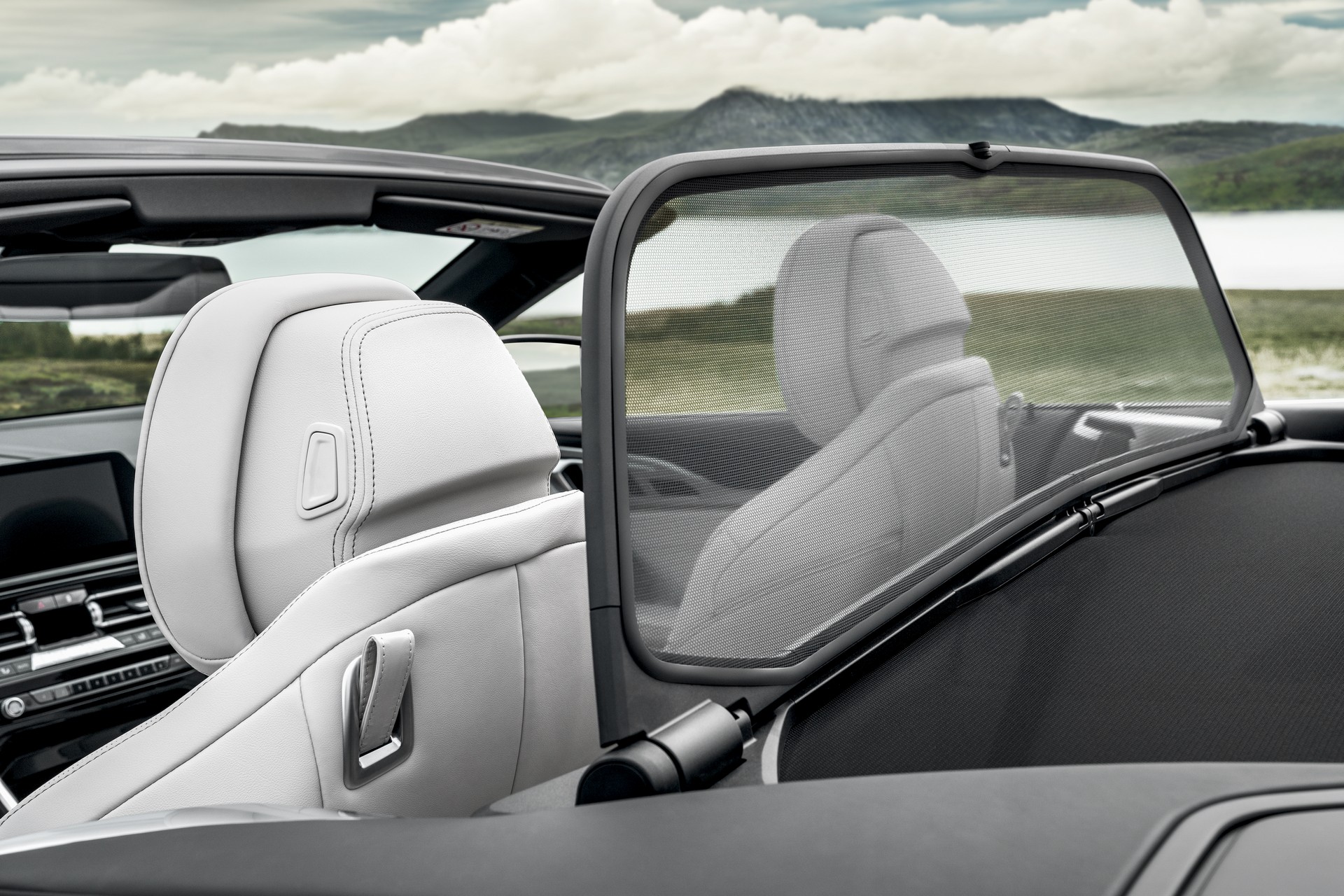
Early tinkerers fought back in the 1930s with crude screens, featured in rags like Popular Mechanics. These homemade baffles, inspired by aircraft canopies, were basic: mesh or canvas to deflect gusts in roadsters. Post-WWII, as leisure boomed with icons like the Chevy Corvette or Jaguar XK, the need intensified. By the 1980s, German precision entered: BMW wove mesh deflectors into the E30 3-Series Convertible, disrupting reverse flows. Porsche added detachable screens to the 911 in the 1990s (993/996 eras), emphasizing lightweight magic. These manual marvels shifted vortex shedding frequencies, dissipating energy before it fatigued you, a CFD-validated win.
The Science of Serenity: Vortices, Strouhal, and CFD Magic
To grasp why deflectors are game-changers, let’s geek out on the aerodynamics. Vortex shedding, the heartbeat of turbulence, happens when air flows past bluff bodies (like your convertible’s open cabin). Picture a cylinder in wind: boundary layers separate alternately, birthing rotating vortices that detach in a staggered “von Kármán vortex street.” In cars, this creates unsteady pressures, wind noise, and buffeting.
CFD (Computational Fluid Dynamics) unveils the drama: Steady models like RANS miss the unsteadiness; we use URANS or LES to capture it, with fine meshes and tiny time steps (100-200 per cycle). A key player? The Strouhal number (St = fD/U), where f is frequency, D diameter, U velocity. For cylinders, St ≈ 0.21 in subcritical Reynolds numbers (300-10^5, auto-relevant). Derived via dimensional analysis from Navier-Stokes, it balances unsteady inertia (fU) against convection (U²/D), emerging empirically from 1878 wire-singing studies by Vincenc Strouhal.
In convertibles, without deflectors, horseshoe vortices recirculate, amplifying Helmholtz resonance booms. Deflectors interrupt: rear meshes raise back-pressure, header spoilers lift shear layers. Result? Shedding frequency spikes, energy dissipates: turbulence drops 70-80%, NVH quiets, and HVAC thrives. Sensational fact: Owners gain weeks of extra top-down time in spring/fall, as reduced convection keeps you toasty.
Visualize the chaos: CFD of vortices sans deflector vs. calm with one.

Mercedes’ Masterstroke: AIRSCARF, AIRCAP, and Patent Wars
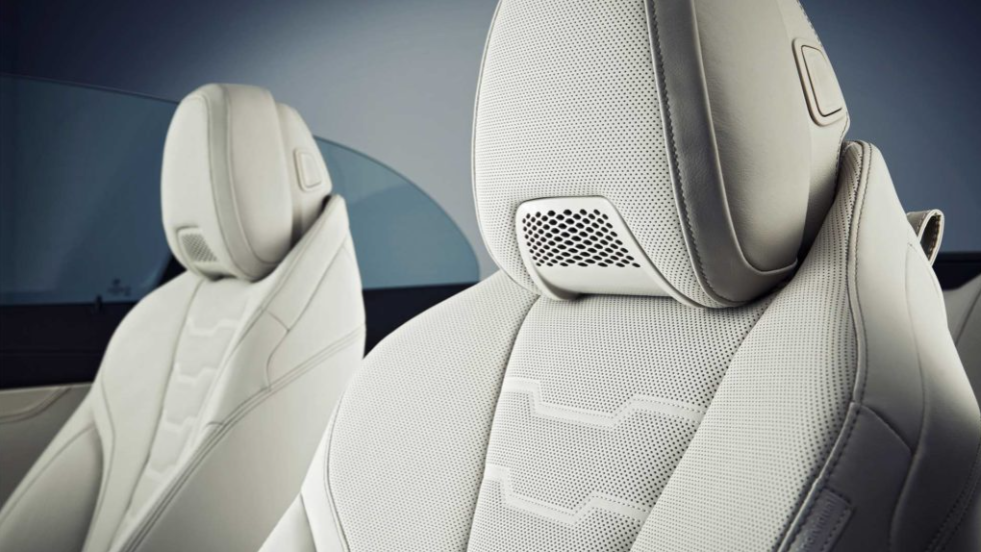
Mercedes didn’t iterate. They innovated holistically, rooted in SL refinement. Enter AIRSCARF: Patented in 1996 by Ludwig Schatzinger, it debuted in the 2004 SLK as headrest vents blasting 40°C air for an “invisible scarf.” Countering wind chill (skin temps above 33°C to avoid fatigue), it echoed 1930s cockpit warmers but scaled for production.
But drama unfolded: In 2016, Germany’s Federal Court ruled Mercedes infringed Schatzinger’s patent, banning AIRSCARF in Germany and threatening €250,000 fines per car. Patent expired Dec 25, 2016, freeing Mercedes.
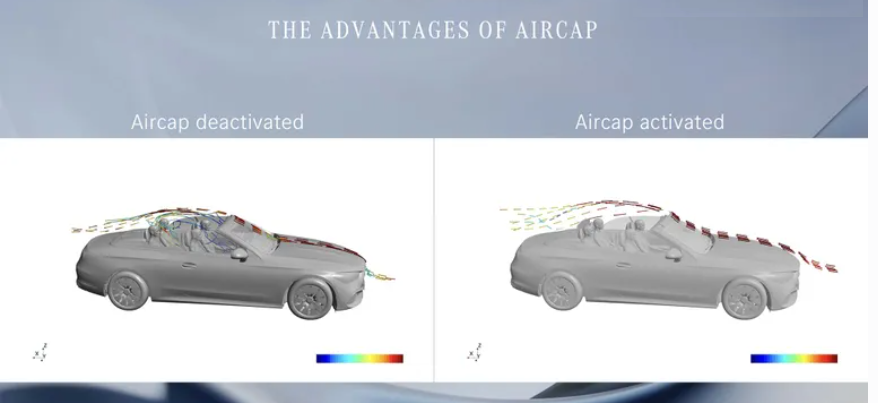
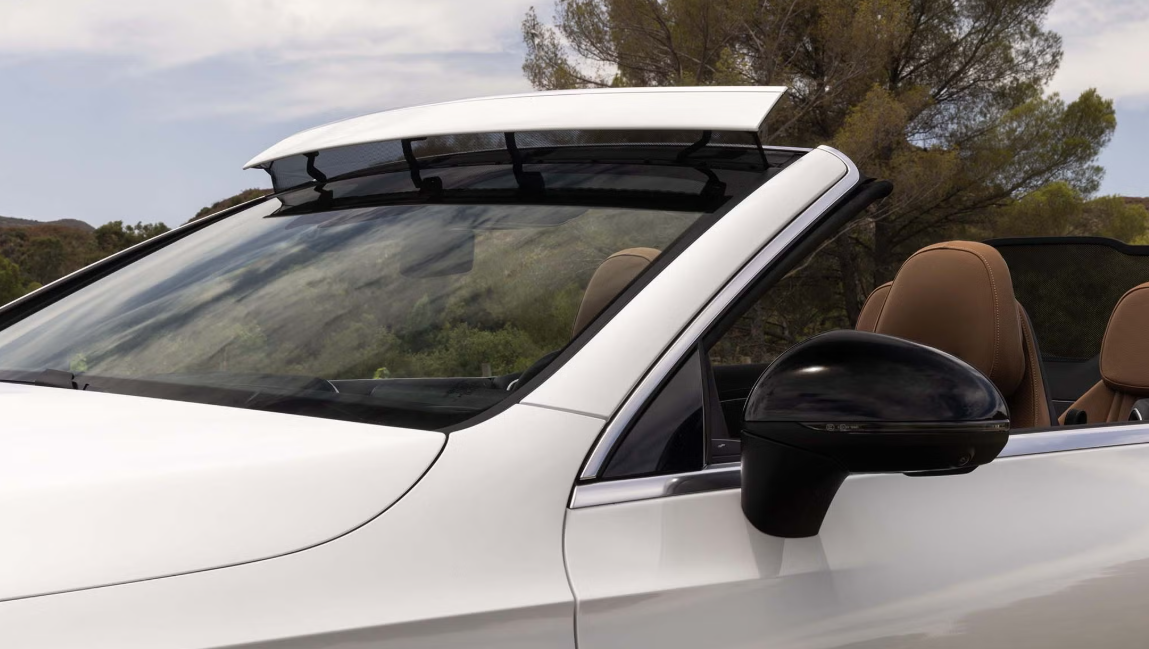
Then AIRCAP (2010 E-Class Cabriolet): A dual patented system (nearly 20 patents, 211 parts from 32 materials) with electric header spoiler (6-8 cm extension) and rear mesh draught-stop. Deploys in <20 seconds, preserves drag when stowed. Synergy with AIRSCARF: Aerodynamics meet thermals for all-season bliss.
See AIRCAP deployed and AIRSCARF vents.

The Ensemble: How Deflectors, Warmers, and Spoilers Harmonize
Technologies intertwined: Mesh vs. solid trade-offs (permeability avoids greenhouse effect but risks vibration); weight (5-10 kg added) vs. usability. Front deflectors elevate flows without sacrificing seats. Neck warmers (BMW’s Air Collar ~2014, Bentley’s discreet) and heated elements amplify. In ultra-luxury, Bentley/Rolls integrate as core DNA, not add-ons, for opulent calm. Porsche’s minimalist meshes shine for purity; Lexus’ LC uses transparent screens.
BMW offers robust framed meshes across 4-Series, Z4, and 8-Series, complemented by “Air Collar” neck warmers since ~2014, adjustable vents bundled in packages.
BMW’s implementation balances sportiness.
What started as simple screens evolved into flow-management systems that reshape separated air, shift vortex-shedding frequencies, and reduce convective heat loss so HVAC systems work with the physics instead of against it.
The real breakthrough wasn’t blocking the wind.
It was controlling boundary conditions.
That’s why modern convertibles no longer rely on single fixes.
Rear wind deflectors, front aero elements, neck warmers, and thermal systems are engineered together, because solving one in isolation creates new problems.
OEMs that do this well treat wind management as architecture, not accessories:
• Mercedes-Benz leads the industry by developing wind deflectors, AIRCAP, and AIRSCARF as one coupled aero-thermal system, enabling true highway-speed, cold-weather top-down driving.
• BMW frames rear deflectors as structural aero devices, pairing them with Air Collar neck warmers and carefully tuned beltline geometry to balance sportiness with flow stability.
• Bentley integrates deployable deflectors, insulation strategy, and neck-level heating directly into the body and interior concept, prioritizing calmness and refinement.
• Aston Martin embeds wind management within surface geometry, seat positioning, and cockpit layout to preserve visual purity while stabilizing cabin flow.
• Lexus, quietly and methodically, focuses on NVH and smooth pressure decay, using transparent deflectors and conservative airflow control to deliver calm, predictable comfort.
Aftermarket fills gaps: Brands like Love The Drive (popular for Mustang/Camaro, 75% reduction claims) or Aperta (European premium, OEM-rivaling) offer value, often illuminated or custom.
The Wind Whisperers’ Legacy
Wind deflectors solved more than discomfort.
They proved that integrated aero-thermal control outperforms isolated fixes.
By managing pressure, vortices, and heat together, modern convertibles became engineered ecosystems, not fair-weather compromises. In an SUV-dominated era, that system-level thinking is what keeps open-top vehicles relevant.
The trade-offs are real.
Mesh permeability prevents pressure traps but demands vibration control.
Solid panels block more flow but add mass and compromise usability.
Active systems add complexity, yet unlock year-round comfort.
What matters is not the solution itself, but when it’s designed in.
Convertible comfort cannot be tuned late.
Wind management must be defined at the architecture phase, alongside beltlines, seating position, and thermal strategy.
10 Engineering Facts That Define Modern Convertible Comfort
Wind deflectors can reduce cabin turbulence by up to ~80%, depending on geometry and speed.
They shift vortex-shedding frequency beyond human sensitivity, reducing fatigue.
They enable HVAC downsizing by cutting convective heat loss.
Wind chill, not ambient temperature, is the primary comfort limiter.
Mesh permeability is intentional, not a cost compromise.
Added mass (5–10 kg) is offset by system-level energy efficiency.
They extend top-down usability by months each year.
Mercedes leads aero-thermal integration with AIRSCARF and AIRCAP.
Ultra-luxury brands integrate wind control into the body-in-white, not as accessories.
The same principles will define future open and modular vehicle architectures.