
Reverse Engineering a $1,300 Porsche Air Inlet
Reverse Engineering a $1,300 Porsche Air Inlet
What Additive Manufacturing Really Gives You Back
The Porsche air inlet example shown below is a publicly available reference used for educational illustration of reverse-engineering and additive manufacturing workflows. The work shown was not performed by OCMEE Design. A real client case study demonstrating OCMEE Design’s application of similar methods is presented in the Reverse Engineering a Lincoln Futura Replica Tail Lamp.
At first glance, this looks like a simple story.
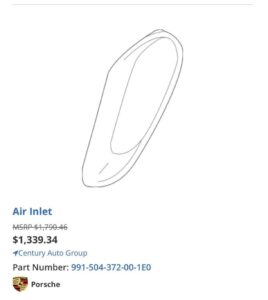
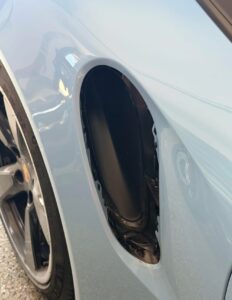
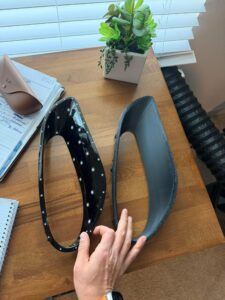
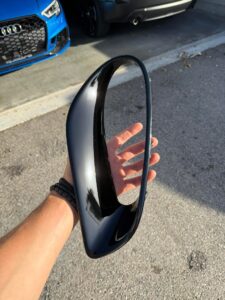
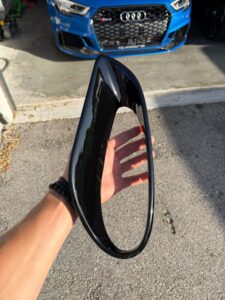
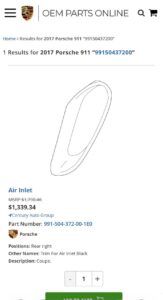
A plastic air inlet trim on a Porsche 911 breaks.
The OEM replacement costs over $1,300.
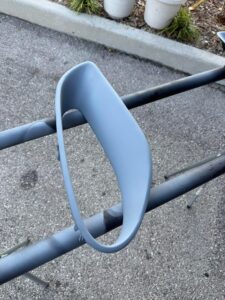
So the owner decides to scan it, model it, 3D print it, and refinish it himself.

The obvious question follows:
Did he save money or time?
That is the wrong question.
This Was Never About a Cheap Replacement
Injection-molded automotive trim does not cost $1,300 to manufacture.
In raw terms, this part likely sits in the $10–$50 range for material and cycle time.
The price comes from:
Tooling amortization
Logistics and storage
Low-volume spare parts strategy
Brand overhead and supply chain control
That is normal in OEM ecosystems.
What makes this project interesting is not that someone avoided paying Porsche.
It is that they took control of the problem.
The Actual Process (And Why It Matters)
This was not a “print and hope” exercise.
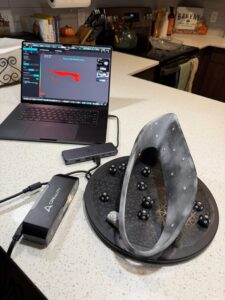
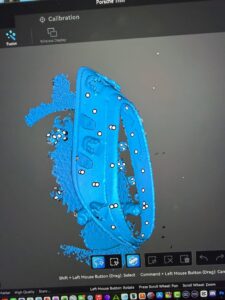
The workflow looked like this:
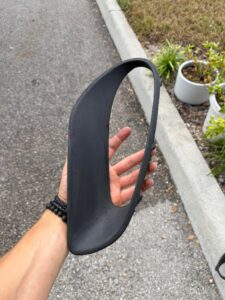
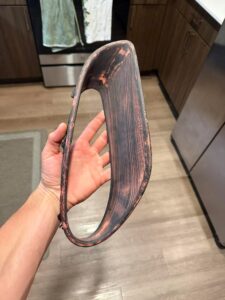
Scan the damaged OEM part to capture real geometry
Clean and rebuild surfaces in CAD
Resolve mounting features, clip geometry, and draft
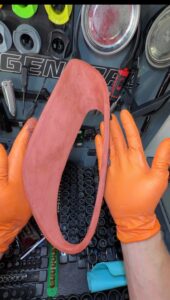
Print multiple iterations to validate fit and stiffness
Adjust wall thickness and local reinforcement
Prime, prep, and paint for an exterior-grade finish
Each step removed uncertainty.
Not just how the part looks, but:
How it locates on the body
How it tolerates assembly variation
How it behaves once installed
This is the difference between replicating shape and re-creating function.
The Real Value: Control and Understanding
This is where reverse engineering and additive manufacturing actually win.
Not in speed.
Not in unit cost.
But in control.
By doing the work himself, the owner separated:
Geometry errors from scan noise
Material behavior from print artifacts
Design intent from OEM manufacturing constraints
That knowledge compounds.
The next part will be faster.
The next decision will be better informed.
The next failure will be cheaper to diagnose.
This is how engineering skill is built in the real world.

Was It Worth It?
If the only goal was to get the car back on the road as quickly as possible, probably not.
Ordering the OEM part would have been simpler.
But if you care about:
Cars
Engineering
Understanding how things actually work
Then yes.
Absolutely.
Because the outcome is not just a part.
It is capability.
What This Says About Additive Manufacturing
Additive manufacturing is often sold as:
Faster
Cheaper
Disruptive
In practice, its biggest strength is quieter and more powerful.
It gives engineers, builders, and enthusiasts agency.
The ability to:
Recreate unavailable or overpriced parts
Improve designs rather than blindly replace them
Learn directly from real geometry and constraints
Reduce dependence on long supply chains
That is not hype.
That is engineering leverage.
Final Thought
This Porsche air inlet did not need to cost $1,300.
More importantly, it did not need to remain a black box.
Reverse engineering turned it into an open problem.
Additive manufacturing turned it into a solvable one.
That is engineering leverage.
At OCMEE Design, we apply this same mindset not only to parts that are expensive, but to parts that do not exist at all: where there are no drawings, no suppliers, and no fallback options.
For a real-world example of how we apply reverse engineering, scanning, CAD surfacing, and iterative prototyping under public deadlines, see our case study:
→ Reverse Engineering a Tail Lamp for a Lincoln Futura Replica for Monterey Car Week